What Is a Real Estate Media Company? How the Profitable Ones Run
Oct 8, 2026 · 12 min read
A real estate media company sells the full listing package, not just photos. See the services menu, team structure and per-listing math behind profitable ones.
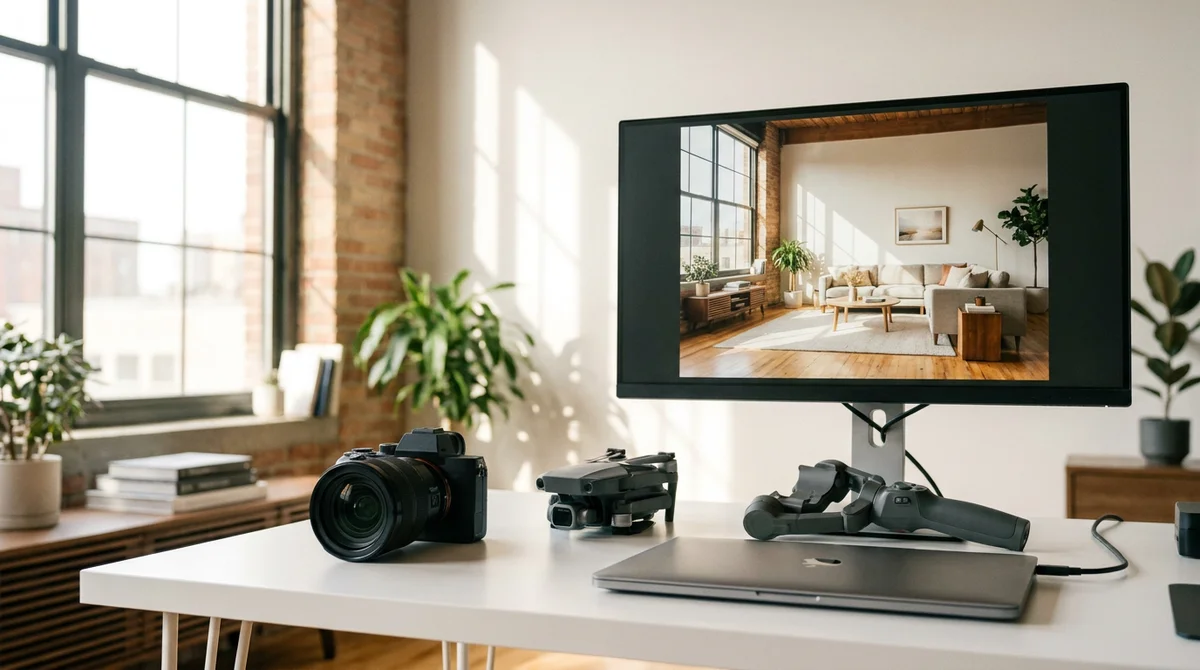
A real estate media company is a business that produces the full set of marketing assets an agent needs to launch a listing: photography, video, drone, floor plans, virtual staging, twilight images and social content. It sells packages, not single shoots, and a team delivers them. The difference from a solo photographer is revenue per listing and capacity.
This guide covers how the profitable ones are built: the services menu, the team, the math on one listing, the AI layer that rewrote the margins, and the three-stage path from a real estate photography business to a media company.
How Is a Real Estate Media Company Different From a Solo Photographer?
The difference is not the camera. It is what gets sold and who delivers it. A solo photographer sells stills, bills $150 to $400 for a standard shoot (RoomLift's pricing data), and is personally the bottleneck on every job. A media company sells a listing launch and staffs it.
| Solo photographer | Real estate media company | |
|---|---|---|
| Services | Interior and exterior stills, sometimes drone | Photos, video, drone, floor plans, 3D tour, virtual staging, twilight, social reels |
| Team | One person shoots, edits, sells and invoices | Owner plus shooters, an editor and a coordinator |
| Turnaround | A day or two, slower when fully booked | Next-day as standard; same-day sold as an add-on (Umedia lists it at $49) |
| Revenue per listing | $150 to $400 for a standard home | $400 to $2,100 per launch kit on Inside Media Co's 2026 price list |
| Capacity | Capped by the owner's calendar | Grows with every shooter added |
The demand side explains why agents buy the bundle. NAR reports that 97% of home buyers search for properties online, and photos are the primary factor in deciding whether to request a showing. The agent wants the listing to look finished everywhere it appears, from the MLS to Instagram, on one invoice. A company that delivers all of it wins the next listing too.
The media-company model is also how photographers cross six figures. We broke the income into three levers in how much real estate photographers make.
What Services Does a Real Estate Media Company Offer?
The menu below uses published 2026 price lists from two US media companies, Umedia and Inside Media Co, plus RoomLift's figures for AI staging. Prices vary by market. The margin logic does not.
| Service | Typical price (2026 price lists) | What it costs you | Margin |
|---|---|---|---|
| HDR photography, standard home | $150 to $400 per shoot | Shooter on site, editing time | Medium: the anchor, priced to win the booking |
| Drone photos and video | $119 to $299 | Licensed pilot, gear, weather delays | Medium to high |
| Video walkthrough | $299 to $600 and up | Shooting and editing hours | Medium |
| Social media reel | $149 to $400 | Editing hours, faster with templates | Medium to high |
| 2D or 3D floor plan | $149 to $219, or bundled | Minutes on site with a scanning app | High |
| 3D tour (Matterport) | $175 to $199 and up | Camera time, hosting fees | Medium |
| Virtual staging | $15 to $30 per photo on lists; $25 to $75 per room (RoomLift) | AI render, about $1 to $5 per image | Very high |
| Virtual twilight | $15 to $25 per photo | One AI edit | Very high |
| Decluttering and enhancement | $3 to $30 per photo | One AI edit | Very high |
Two data points justify the non-photo lines agents ask about most. RICS reports that listings with floor plans receive 30% more engagement than those without. Wyzowl's State of Video Marketing finds 91% of businesses now use video as a marketing tool. Agents who know those numbers buy the plan and the reel.
The last three rows carry the company. Staging, twilight and enhancement need no site time and no gear. RoomLift produces a staged image for about $1 to $5 in under 60 seconds, and photographers typically bill $25 to $75 per room, so most of every staged photo is margin. That is why the five upsells with the best price, margin and turnaround are all digital.
How Does the Team Grow as a Media Company Scales?
The order of hires is nearly always the same, because each hire removes the bottleneck the previous stage created.

Owner-shooter. One person shoots, edits, sells and invoices. Revenue is capped by the calendar, so the first move is not a hire. It is adding digital services that raise revenue per listing without adding shoots.
Plus shooters. When the calendar is full, add a second shooter, usually a contractor at first. The owner keeps the top clients and every sales conversation, and writes the shooting standard down so two people produce the same look.
Editor. Zillow research says listings with 22 to 27 photos get the most buyer engagement. At 25 photos per listing and 40 listings a month, that is 1,000 images through the editing queue every month. An editor, in-house or contracted, is what lets shooters shoot.
Coordinator. Scheduling, delivery, invoicing and agent follow-up eat the owner's hours next. A coordinator takes them, and the owner moves to sales and quality control.
Keep shooting, sales and pricing in-house; they are the product and the client relationship. Staging, twilight and enhancement stay in-house too, since AI tools make them minutes per image. Send overflow shoots to vetted contractors, long-form cinematic edits to a freelancer until volume justifies an editor, and floor-plan drafting out only if you measure by hand. Booking and delivery software covers admin until a coordinator makes sense.
What Are the Unit Economics of One Listing?
The revenue model is a base shoot at a competitive rate plus add-ons attached to the same visit. The base wins the booking; the add-ons make the money. Here is a standard 2,000 sq ft listing priced from the 2026 lists above.
| Line item | Price | Direct cost | Note |
|---|---|---|---|
| HDR photography, standard home | $250 | Shooter time, editing | Anchor, inside the $150 to $400 band |
| 2D floor plan | $149 | Minutes on site with a scanning app | Umedia list price |
| Social media reel | $149 | Templated edit from walkthrough clips | Umedia list price |
| Virtual twilight, front exterior | $25 | About $1 to $5 in AI credits | Inside Media Co list price |
| Virtual staging, 2 rooms at $50 | $100 | About $2 to $10 in AI credits | Inside RoomLift's $25 to $75 per room band |
| Package total | $673 | 2.7x the stills-only invoice |
Every line after the first was captured on the same visit. The floor plan takes minutes with a scanning app. The reel is cut from clips the shooter recorded while walking the house. The twilight and staging are AI edits on photos already taken, so nearly all of the extra $423 is margin.
Agents pay because the outcome is documented. In NAR's Profile of Home Staging, 23% of buyer's agents reported a 1% to 5% increase in the dollar value offered for staged homes, and 18% reported 6% to 10%. RESA puts the average at 1% to 5% more. On a $400,000 listing, 1% is $4,000. A $100 staging line is not a hard sell against that.
Agents buy tiers, not line items, so present the same math as good, better and best, with the floor plan and reel in the middle tier. Our guide to real estate photography packages shows how to build the three tiers so most agents land in the middle.
How Did AI Change the Margins?
Until recently the digital rows on the menu were vendor work. Staging went out to a service with a multi-day turnaround, and a rendered concept cost $200 to $500 per image (RoomLift). Twilight meant a second trip at dusk. Reels meant an editor on retainer. Each vendor took a slice, and each handoff added a day.
AI tools collapsed that chain. RoomLift stages an empty room for about $1 to $5 per image in under 60 seconds. Photo Enhance runs virtual twilight, decluttering, HDR enhance and sky replacement on the same photo set. Video Maker cuts the photos and clips into a listing reel. One person in the office now covers what used to need three vendors, and the company keeps the whole invoice.
RoomLift platform data shows what media companies and agents actually order. Declutter is the most requested photo-edit preset at 28% of requests, followed by add realism, golden hour and virtual twilight at 13% each, and HDR enhance at 12%. Living rooms and bedrooms make up 59% of staging requests, and Modern and Scandinavian styles cover 60% of them.
Video is still the smallest slice, about 2.6% of all generations on the platform, and that is the gap. Wyzowl finds 85% of consumers say a video convinced them to buy something, yet most listings still launch without one. A media company that packages a reel by default is selling into demand its competitors have not met.
The workflow built for this is on our page for real estate photographers: upload the shoot, stage the empty rooms, run the enhancement presets and export the reel. The photo editing tools take images only, so nothing about your capture changes.
Turn one shoot into staging, twilight and a reel the same day. Try RoomLift with 5 free renders on signup.
Stage your first room in 20 seconds. No design skills needed.
How Do Photographers Make the Transition?
Going from a real estate photography business to a media company happens in three stages. Each one raises revenue before it raises cost.
Stage 1: Add digital services to the shoots you already do. No new gear, no new trips. Put virtual staging on the price list at $25 to $75 per room, add virtual twilight at the $15 to $25 the 2026 price lists above charge, and offer decluttering alongside. Stage the living room first on every vacant listing: NAR finds 46% of buyer's agents say it is the most important room to stage, and RoomLift platform data shows it is 30% of all staging requests.
Stage 2: Package and raise the average order. Build three tiers and put the floor plan and reel in the middle one. The pitch for the base tier is speed: Zillow research finds listings with high-quality photos sell up to 32% faster. The pitch for the upper tiers is reach, since floor plans, video and staging each carry a documented lift. Most agents choose the middle, which is where your margin sits.
Stage 3: Hire for capacity. Add a second shooter when the calendar is full, then an editor, then a coordinator. Keep sales and quality control with the owner. From here the company earns from every listing in the pipeline, not just the ones the founder shoots.
The order matters: add the digital services first, and the add-ons on listings you already shoot pay for the hires.
Frequently Asked Questions
What is a real estate media company?
A real estate media company produces the full set of marketing assets an agent needs to launch a listing: photos, video, drone, floor plans, virtual staging, twilight images and social content. It sells packages rather than single shoots, so one visit can bill $400 to $2,100 depending on the tier, based on Inside Media Co's published 2026 price list. Most start as a solo photographer and add services one at a time.
How is a real estate media company different from a real estate photographer?
A solo photographer sells one service, stills, and bills $150 to $400 for a standard shoot. A media company sells the whole listing package and a team delivers it, which pushes revenue per listing well past the base rate. The other difference is capacity: a team can shoot, edit and deliver more listings per week than one person, so revenue is not capped by the owner's calendar.
What services does a real estate media company offer?
The core menu is HDR photography, video walkthroughs, social reels, drone photos and video, 2D or 3D floor plans, 3D tours, virtual staging, virtual twilight and photo enhancement. Published 2026 price lists put social reels at about $149, drone photo and video at $299 and virtual staging at $15 to $30 per photo. The best-margin items are the digital ones, because they are produced from photos the company already shot.
How much does a real estate media company make per listing?
A stills-only shoot brings in $150 to $400 for a standard home. Attaching a floor plan, a reel, a virtual twilight and two virtually staged rooms to the same visit adds about $423 at published 2026 rates, so the package lands near $673 instead of $250. Luxury bundles with drone and cinematic video reach $1,300 to $2,100 on some price lists.
How many people do you need to start a real estate media company?
One. Most media companies start with an owner who shoots, edits and sells, then add a second shooter when the calendar is full. An editor comes next, then a coordinator who handles scheduling and delivery. AI tools for staging, twilight and enhancement let a two or three person team offer a menu that used to need a separate vendor for each service.
Sources & References
- National Association of Realtors (2025). Profile of Home Staging. NAR Research.
- National Association of Realtors (2025). Highlights From the Profile of Home Buyers and Sellers. NAR Research.
- Real Estate Staging Association. Home Staging Statistics. RESA.
- PlanOmatic. How Many Listing Photos to Include in Your Real Estate Marketing, citing Zillow research. PlanOmatic Blog.
- Wyzowl (2026). Video Marketing Statistics. Wyzowl.
- Umedia (2026). Real Estate Media Pricing. Umedia Services.
- Inside Media Co (2026). Services and Pricing. Inside Media Co.
Ready to transform your listings?
Stage your first room in 20 seconds. No design skills needed.