Real Estate Photography Software: The 2026 Media Company Stack
Oct 1, 2026 · 15 min read
Real estate photography software mapped by layer: booking and CRM, delivery, editing, AI staging, video, floor plans and invoicing, plus three stack recipes.

Real estate photography software is not one product. A working media company runs seven layers: booking and CRM, delivery, editing, staging and enhancement, video, floor plans and 3D tours, and invoicing. This guide maps real tools to each layer and ends with three ready-made stacks: solo shooter, three-shooter company, and a team of ten or more.
Why Does a Media Company Need Seven Layers of Software?
Agents judge a media company on two things: how easy it is to book, and how fast the photos arrive. NAR reports that 97% of home buyers search for properties online and that photos are the primary factor in deciding whether to request a showing, so the agent's entire listing launch depends on your delivery day.
The trap is buying one all-in-one platform and calling the stack done. Those platforms cover booking, delivery and invoicing well. They do not draw floor plans, cut reels, or stage empty rooms, and that is where the margin sits. Vendor prices in this guide are list prices at the time of writing, taken from the pricing pages linked under Sources.
| Layer | Tool options | Who it is for |
|---|---|---|
| 1. Booking, scheduling, CRM | HDPhotoHub, Aryeo, Spiro, Tonomo | Any company taking more than a handful of orders a week |
| 2. Delivery and property websites | Aryeo, HDPhotoHub, Spiro, Rela, Pixieset | Everyone; agents judge you on this page |
| 3. Editing | RAW editors and outsourced editing partners | Every shooter, every job |
| 4. Staging, twilight, enhancement | RoomLift (Restyle, Photo Enhance) | Anyone shooting vacant listings or flat midday exteriors |
| 5. Video and reels | RoomLift Video Maker | Companies selling reels and tours without a videographer |
| 6. Floor plans and 3D tours | CubiCasa, Matterport, Zillow 3D Home | Companies that attach a floor plan or tour to every listing |
| 7. Invoicing and payments | Built into Aryeo, HDPhotoHub, Tonomo; or Wave, QuickBooks | Solo shooters (Wave) up to multi-shooter payroll (QuickBooks) |
Volume is why the stack has to be tight. Zillow research found listings with 22-27 photos get the most buyer engagement, so every job pushes two dozen or more edited files through delivery, and any friction repeats on every listing.
Which Booking, Scheduling and CRM Software Do Real Estate Photographers Use?
Real estate photography booking software does three jobs. It lets an agent order and pay without calling you, it drops the job onto the right shooter's calendar, and it keeps the agent's history so you can market to them later. That history is the CRM, and it lives inside the booking platform.
HDPhotoHub is white-label, so the agent sees only your brand. Scheduling accounts for drive times and shoot durations, the branded cart suggests add-ons and takes Stripe or Square payments with deposits and promo codes, and it integrates with QuickBooks. Who it suits: multi-shooter companies that want the client experience under their own name.
Aryeo reports serving over 250,000 real estate professionals. Aryeo Lite is free forever and covers delivery. Aryeo Pro starts at $49 a month for 100 annual listings and one team member, rising to $99 for 250 listings and three members and $179 for 500 listings and five, and adds advanced scheduling, invoicing, reporting, a mobile app and Zillow 3D Home integration. Who it suits: solo shooters who start free and grow by listing count.
Spiro charges $5 per listing with no subscription, covering a client grid with CRM functions, property websites, agent marketing kits, custom order pages, automated workflows and delivery. Who it suits: seasonal or low-volume companies that would rather pay per job.
Tonomo is built around routing. It assigns photographers automatically by skill and location with a travel-time view, recommends upsells in the booking flow, and pushes invoices to Xero. Who it suits: three or more shooters, where the owner's day disappears into dispatch.
A photographer's CRM is mostly a list of agents ranked by how many listings they sent you this year, and the repeat bookers are the ones to pitch on staging and video.
How Should You Deliver Photos and Property Websites?
Real estate photo delivery has one rule: the agent should never need a login to get MLS-sized files. It is also the only screen the agent sees on every job, so it doubles as your brand.
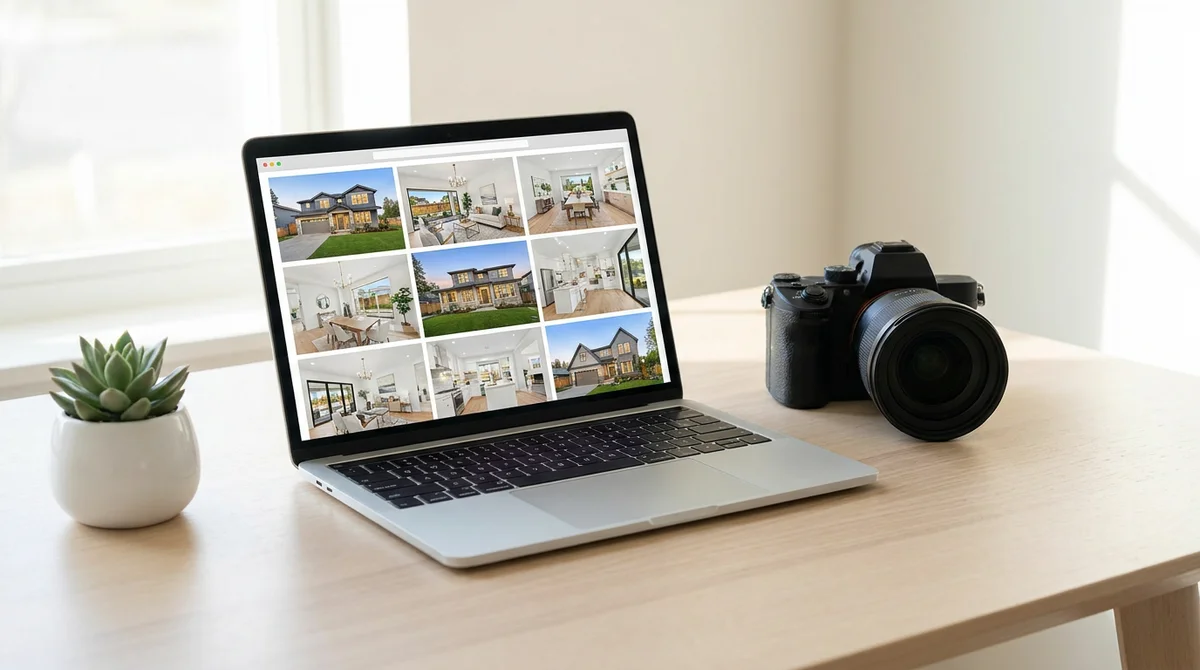
Aryeo Lite includes branded delivery pages, an agent login portal and Zillow Showcase integration for free. Who it suits: any shooter who wants a proper delivery page before paying for a platform.
HDPhotoHub delivers photos, video, PDFs and embedded Matterport tours through login-free pages, resizes for MLS automatically, and offers pay-to-download. Its Property Marketing Kit adds property websites, social graphics and flyers. Who it suits: companies that sell the property website as a line item.
Spiro bundles property websites into its $5 per listing. Rela is known for single-property websites; we could not verify its current pages at the time of writing, so check its offer directly.
Pixieset is a general photographer gallery, not a real estate ordering system. The Free plan gives 3 GB of storage, and paid plans run from $8 a month billed annually (10 GB) to $40 (unlimited storage). Who it suits: hybrid photographers who also shoot weddings or portraits.
What About Editing Software?
Editing is its own layer, and we compared the tools in our real estate photo editing software guide, so this article will not re-review them. The standard is not negotiable: Zillow research found listings with high-quality photos sell up to 32% faster. Our AI real estate photo editing workflow lays out a cull, correct, declutter, sky, twilight, stage and upscale sequence that gets a full listing client-ready in under an hour.
Where Do Virtual Staging, Twilight and Enhancement Fit?
This is the layer most all-in-one platforms leave out, and it carries the best margin in the stack. RoomLift's figures: AI virtual staging costs about $1 to $5 per image and takes under 60 seconds, while photographers typically bill $25 to $75 per virtually staged room. The staged photo is a second deliverable made from a photo you already shot.
RoomLift platform data across more than 10,000 AI generations in the 12 months to September 2026 shows what agents order. Declutter leads photo-edit presets at 28%, followed by add realism, golden hour and virtual twilight at 13% each and HDR enhance at 12%. Modern (31%) and Scandinavian (29%) cover six in ten staging style requests, and living rooms (30%) and bedrooms (29%) are staged most. NAR agrees: 46% of buyer's agents call the living room the most important room to stage.
RoomLift covers the layer with two tools. Restyle stages an empty-room photo in a chosen style and room type. Photo Enhance runs declutter, virtual twilight, golden hour, HDR enhance and sky replacement on photos you already delivered. Both take images (JPG, PNG, exported views), not model files, and you get 5 free renders on signup. The RoomLift for photographers page shows the presets and the per-photo economics.
Agents pay because staging works. NAR found 81% of buyers say staging makes it easier to picture a property as their own, and RESA reports staged homes sell for 1-5% more on average. We priced each add-on, with margin and turnaround, in 5 things real estate media companies can upsell.
How Do Media Companies Add Video and Reels Without a Videographer?
Wyzowl's State of Video Marketing found 91% of businesses use video as a marketing tool and 85% of consumers say a video convinced them to buy. Agents want a reel for the listing launch, but a videographer's day rate on a standard $150 to $400 shoot (RoomLift's benchmark) kills the margin.
RoomLift Video Maker turns the delivered photo set, staged and twilight images included, into a listing tour or vertical reel. Pick a template and aspect ratio, order the photos, add captions, music and voiceover, and export the MP4 to the same delivery page. Video is about 2.6% of all generations in RoomLift platform data, so it is still an under-sold add-on. The AI real estate video maker page walks through the templates.
Which Floor Plan and 3D Tour Software Belongs in the Stack?
Floor plans are the cheapest add-on to attach to every listing. RICS found listings with floor plans receive 30% more engagement than those without.
CubiCasa makes floor plans from a phone scan. The first 2D floor plan is free, turnaround is 24 hours on 2D and 48 hours on 3D with a 6-hour rush add-on, and photographers in the Preferred Photographer Program get up to 25% discounts. Plans appear on Realtor.com and Redfin listings automatically. Who it suits: every shooter, from day one.
Matterport is the 3D tour standard for luxury and commercial listings. The Free plan covers 1 Active Space and 2 users, Starter covers 5-20 Active Spaces and adds floor plans, Professional covers 20-150 Active Spaces and 10 users, and annual billing saves up to 16%. Who it suits: companies that sell tours as a premium line and can justify the camera.
Zillow 3D Home is Zillow's own tour format, and Aryeo Pro connects to it directly. Who it suits: shooters whose agents want the tour on the Zillow listing itself.
RoomLift's Plan to Dollhouse turns a 3D cutaway plan image (not a flat 2D plan) into a furnished marketing visual: a presentation image, not a measured drawing.
What Do You Need for Invoicing and Payments?
If you run Aryeo Pro, HDPhotoHub or Tonomo, invoicing is already inside the platform. Standalone accounting is for the books behind it, not for billing agents.
Wave Starter is free with unlimited invoices and estimates, and card payments cost 2.9% plus $0.60 per transaction. Pro is $19 a month or $190 a year and adds bank imports. Who it suits: solo shooters and two-person companies.
QuickBooks Online lists Simple Start at $38 a month, Essentials at $85, Plus at $140 and Advanced at $340, with introductory discounts that change often. Who it suits: companies paying contractor shooters and editors.
How Do Staged Images Flow Back Into Delivery?
The stack pays off only when the add-on layers feed delivery cleanly. Here is the loop on a vacant listing.
- Deliver the base set first. Upload the standard photos on day one so the agent waits for nothing.
- Sell the add-on at order time. HDPhotoHub's cart suggests add-ons at checkout and Tonomo recommends upsells in the booking flow, so the staging order exists before you open RoomLift.
- Stage from the edited export. Upload the finished empty-room JPG to Restyle, pick the room type and style the agent chose, and export at the delivered resolution. At under 60 seconds per image, a four-room order takes minutes.
- Name files to sit next to the originals. A file called 12-living-room-staged.jpg lands beside 12-living-room.jpg. Many MLS boards require virtually staged images to be labeled, so keep the empty original in the same delivery.
- Upload back to the same delivery page so the agent gets one link and one invoice line, then pull the staged set into Video Maker and add the MP4 alongside.
Aryeo Pro lists its own Virtual Staging AI, which covers the occasional room. Keeping RoomLift in the stack means one account handles staging, Photo Enhance presets and Video Maker, so the add-on layer stays in one tool and the delivery platform stays the hub. Living rooms and bedrooms are 59% of staging requests in RoomLift platform data, so a two-room default package covers most orders.
Turn the empty rooms you already shot into $25 to $75 per-room deliverables. Stage a listing photo with RoomLift in under a minute, with 5 free renders on signup.
Stage your first room in 20 seconds. No design skills needed.
Three Stack Recipes: Solo Shooter, 3-Shooter Company, 10+ Team
The right stack tracks order volume and headcount, not the feature list. RoomLift's benchmark for a standard shoot is $150 to $400, with larger or luxury homes at $400 to $800 once drone, twilight and video are added, so the software budget should stay a small fraction of one job.
| Layer | Solo shooter | 3-shooter company | 10+ team |
|---|---|---|---|
| Booking, scheduling, CRM | Aryeo Lite, then Aryeo Pro ($49/mo) once orders pass a few a week | Aryeo $99 tier (3 members) or Tonomo for auto-assignment | HDPhotoHub white-label or Aryeo Enterprise |
| Delivery, property sites | Aryeo Lite delivery pages | Same platform as booking | Same platform, branded mobile app |
| Editing | In-house RAW editing | Outsourced editing partner with a house style guide | Editing team with a QA lead |
| Staging, twilight, enhancement | RoomLift Restyle and Photo Enhance, pay per image | RoomLift, one shared account | RoomLift, whole-listing bulk workflows |
| Video and reels | RoomLift Video Maker from stills | Video Maker plus one shooter on drone | Video Maker for reels; videographer for luxury only |
| Floor plans, 3D tours | CubiCasa (first 2D plan free) | CubiCasa with the Preferred Photographer discount | CubiCasa plus Matterport Professional |
| Invoicing | Platform invoicing plus Wave Starter (free) | Platform invoicing plus Wave Pro ($19/mo) or QuickBooks Simple Start ($38) | QuickBooks Plus ($140) with payroll |
Solo shooter. Start on free tiers and spend on the layer that bills back: staging at roughly $1 to $5 per image against $25 to $75 billed per room. Move to Aryeo Pro when scheduling by text message starts costing you jobs.
3-shooter company. The bottleneck becomes routing and consistency. Tonomo's auto-assignment or Aryeo's $99 tier keeps three calendars honest, and one shared RoomLift account gives every vacant listing the same staging menu.
10+ team. Volume changes the client mix. RoomLift platform data shows property developers generate about 47 AI generations per active user against about 7.5 for agents, so a team serving developers needs bulk staging per listing and a white-label platform.
Frequently Asked Questions
What software do real estate photographers use?
Most real estate photographers run a stack rather than one app: a booking and delivery platform such as Aryeo (Pro from $49 a month), HDPhotoHub, Spiro ($5 per listing) or Tonomo, a RAW editor, an AI staging tool such as RoomLift, a floor plan app such as CubiCasa, and invoicing through the platform or Wave or QuickBooks. The booking platform is the hub. The specialist tools cover the add-ons that carry the margin.
What is the best real estate photography CRM?
For most media companies the CRM is built into the booking platform, so the best choice depends on team size. Aryeo's tiers scale by listing volume ($49, $99 and $179 a month for 100, 250 and 500 annual listings), HDPhotoHub keeps client profiles with order history, and Tonomo assigns photographers automatically by skill and location. A separate sales CRM only makes sense once you have a dedicated salesperson pitching brokerages.
How do real estate photographers deliver photos to clients?
Through a branded delivery page the agent can open without a login, with MLS-sized and full-resolution downloads side by side. Aryeo Lite offers branded delivery pages and an agent portal for free, HDPhotoHub adds automatic MLS resizing and pay-to-download, and Pixieset's free plan gives 3 GB of gallery storage. Zillow research found listings with 22-27 photos get the most buyer engagement, so the page needs to move that many files fast.
How does AI virtual staging fit into a photography software stack?
It sits between editing and delivery as an add-on layer. You upload the edited empty-room photo to RoomLift, choose a room type and style, get a staged image back in under 60 seconds for about $1 to $5, and upload it to the same delivery page as the original. Photographers typically bill $25 to $75 per staged room, and NAR reports 81% of buyers say staging makes it easier to picture a property as their own.
How much does a real estate photography software stack cost per month?
A solo shooter can run booking, delivery and invoicing for under $100 a month: Aryeo Pro at $49, Wave's free Starter plan, and the first CubiCasa 2D floor plan free. A three-shooter company on Aryeo's $99 tier plus QuickBooks Simple Start at $38 lands near $140 before staging and floor plan costs. AI staging is pay-per-use at roughly $1 to $5 per image, so it scales with what you bill, not with headcount.
Sources & References
- National Association of Realtors (2025). Profile of Home Staging. NAR Research.
- National Association of Realtors (2025). Highlights From the Profile of Home Buyers and Sellers. NAR Research.
- Real Estate Staging Association. RESA home staging statistics. RESA.
- Zillow Research. Zillow Research. Zillow.
- RICS. Royal Institution of Chartered Surveyors. RICS.
- Wyzowl (2026). Video Marketing Statistics. Wyzowl.
- Aryeo (2026). Aryeo Pricing. Aryeo.
- HDPhotoHub (2026). HDPhotoHub platform overview. HDPhotoHub.
- Spiro (2026). Spiro real estate media software. Spiro.
- Tonomo (2026). Tonomo real estate photography CRM. Tonomo.
- Pixieset (2026). Pixieset Client Gallery Pricing. Pixieset.
- CubiCasa (2026). CubiCasa Pricing. CubiCasa.
- Matterport (2026). Matterport Plans. Matterport.
- Wave (2026). Wave Pricing. Wave Financial.
- Intuit (2026). QuickBooks Online Pricing. Intuit.
Ready to transform your listings?
Stage your first room in 20 seconds. No design skills needed.