AI for Real Estate Lead Generation: Strategies That Work in 2026
Feb 23, 2026 · 6 min read
How real estate agents are using AI tools to generate more leads, close listings faster, and reduce marketing costs. From AI virtual staging to automated listing descriptions — a practical guide for 2026.

Real estate is, fundamentally, a marketing business. The agent with the best listings, the most compelling photography, the most articulate property descriptions, and the fastest response time wins more business. In 2026, AI has become the most significant competitive advantage available to agents who understand how to use it — and a growing liability for those who don't.
This guide covers practical, proven AI strategies that real estate agents are using today to generate more leads, present listings more effectively, and close transactions faster.
Why Visual Marketing Determines Real Estate Lead Volume
Before any other lead generation strategy, agents need to understand where real estate leads actually come from in 2026.
According to the National Association of Realtors' 2025 Profile of Homebuyers and Sellers:
- 97% of home buyers use the internet in their home search
- Photos are the #1 factor buyers use when deciding whether to request a showing
- Staged homes sell 73% faster than unstaged equivalents
- Properties with high-quality professional photos receive 47% more per square foot in asking price
The implication is direct: the quality of a listing's visual presentation is the most controllable variable in how many leads it generates online. Everything else — location, price, school district — is fixed. The photos are within the agent's control.
AI Virtual Staging: The Highest-ROI Tool Available
Traditional physical staging costs $1,000–$5,000 per property and requires 3–5 days of lead time. This means many agents skip staging entirely for mid-market listings — accepting worse photography and fewer leads as the cost of saving the staging budget.
AI virtual staging eliminates this trade-off.
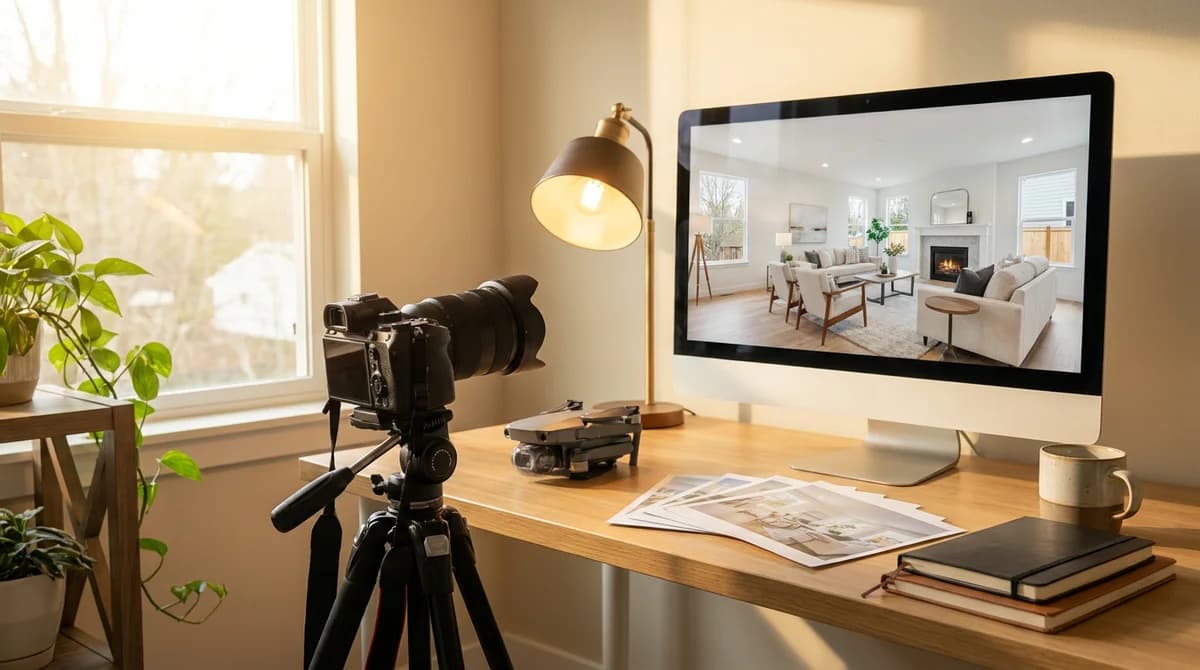
How it works: The agent uploads photos of the empty property to an AI tool like RoomLift. The AI analyzes the room's dimensions, natural light, and architecture, then generates photorealistic renders showing the room fully furnished and staged — in under 60 seconds per room.
Cost: $1–5 per image, versus $200–500 for a single professional virtual staging service, or $1,000–5,000 for physical staging.
Quality: Modern AI staging produces results indistinguishable from professional virtual staging in most cases, and competitive with good physical staging at the photography level.
ROI calculation: If AI-staged photos increase a listing's average days on market by even 10 days (through higher inquiry volume and stronger offers), the $30–100 total AI staging cost for a property represents an extraordinary return on investment.
Practical Workflow for AI Staging
- Take the property photos (follow standard real estate photography guidelines)
- Upload to RoomLift — upload the empty room photos
- Select the staging style appropriate for the property and target demographic (Japandi and Modern Farmhouse for urban/suburban properties; Traditional for classic homes; Coastal for near-water properties)
- Download the staged renders
- Include disclosure in the MLS listing that photos have been digitally enhanced
The entire process takes 20–30 minutes for a standard 3-bedroom property — comparable to writing the listing description.
AI for Listing Descriptions That Convert
Property descriptions are frequently the weakest element of real estate listings. Agents who write their own descriptions often produce technically accurate but emotionally flat copy that doesn't create desire in the buyer.
AI writing tools (including ChatGPT, Claude, and specialized real estate copywriting tools) can generate compelling listing descriptions in seconds when given the right inputs:
Inputs to provide:
- Property address and basic specifications (beds, baths, square footage)
- 5–10 specific selling points (renovated kitchen, south-facing garden, walk to station)
- Target buyer profile (first-time buyer, family upgrading, investor)
- Desired tone (lifestyle-focused, investment-focused, family-focused)
Output quality: AI-generated listing descriptions typically require editing but provide a strong structural foundation — the key emotional beats, the right feature sequencing, and vocabulary that buyers respond to.
The most effective approach: use AI to generate a first draft in 30 seconds, then spend 5 minutes editing to reflect specific details only the agent knows — neighborhood context, recent improvements, unique history.
AI for Social Media Marketing
Real estate social media content requires volume (consistent posting), quality (professional visuals), and relevance (local market context). AI tools address all three:
Visual content: AI-generated before/after staging comparisons, style visualization renders, and floor plan annotations create scroll-stopping content that outperforms stock photography consistently.
Caption writing: AI can generate Instagram, Facebook, and LinkedIn captions in the agent's voice, adapted to each platform's optimal format.
Market analysis content: AI tools can summarize market statistics, days-on-market trends, and price comparisons into readable, shareable social posts that position the agent as a market expert.
Volume: An agent who previously created 3–4 pieces of content per week can produce 15–20 pieces of high-quality content in the same time using AI tools effectively.
AI-Powered Lead Follow-Up
Studies consistently show that the speed of response after a lead inquiry is the strongest predictor of conversion. MIT research found that responding within 5 minutes versus 30 minutes increases lead qualification rates by 100x.
AI tools help agents manage follow-up at scale:
- Automated initial response: AI can send a personalized, contextual first response within seconds of a new lead inquiry — including the property's key details and available showing times
- Nurture sequences: AI-powered CRM tools can maintain contact with leads over months, sending relevant market updates, new listings, and check-in messages at optimal intervals
- Lead scoring: AI models can analyze lead behavior (which listings they viewed, how long they spent on each, whether they saved the property) to prioritize which leads deserve immediate personal contact
Building an AI-Enabled Lead Generation System
The most effective approach combines multiple AI tools into a coherent workflow:
- Listing presentation: AI virtual staging + AI listing descriptions → higher-quality marketing assets
- Distribution: Professional photos → Zillow, Realtor.com, social media → more impressions per listing
- Lead capture: Stronger visual marketing → higher click-to-inquiry conversion
- Follow-up: AI CRM tools → faster, more consistent lead nurturing
- Conversion: Better-presented properties → shorter time to showing → shorter time to offer
Each step in this system compounds the previous one. Agents who implement AI at all five stages report 30–50% increases in lead volume from the same marketing budget according to industry surveys.
Getting Started: A Practical Priority Order
For agents new to AI tools, the highest-ROI starting point is visual marketing — specifically AI virtual staging for listings with empty rooms or poor existing staging.
- Sign up for RoomLift (5 free renders, no credit card required)
- Test AI staging on your next empty property listing
- Compare inquiry rates against similar properties without staging
- Expand to AI listing descriptions once you've established the staging workflow
- Add AI-powered social media content once both previous steps are routine
The compound effect of consistent AI adoption is significant. Agents who make this transition early build a systematic advantage that becomes increasingly difficult for competitors to replicate.
Sources & References
- National Association of Realtors (2024). Real Estate in a Digital Age Report. NAR Research Reports.
- HubSpot (2024). State of Marketing Report. HubSpot Research.
Ready to transform your listings?
Stage your first room in 20 seconds. No design skills needed.