Mid Century Modern Interior Design: A Complete Style Guide
Feb 23, 2026 · 6 min read
The definitive guide to mid century modern (MCM) interior design — defining characteristics, color palettes, furniture icons, room-by-room application, and how to use AI to visualize MCM in your home.
Mid century modern interior design emerged from one of design history's most creatively fertile periods. Between 1945 and 1969, a generation of designers and architects — working with new materials like molded plywood, fiberglass, and aluminum — produced furniture and spaces that were simultaneously functional, beautiful, and democratic. More than 70 years later, their work remains among the most commercially successful and culturally influential design in history.
Understanding MCM means understanding both its historical context and its formal principles. The style's longevity comes not from nostalgia but from the genuine quality of its visual logic.
The Historical Context of Mid Century Modern Design
Post-war America and Europe experienced simultaneous economic expansion, technological innovation, and a profound cultural desire to leave behind the past. The GI Bill funded suburban home construction at an unprecedented rate. New manufacturing processes made materials like molded plywood, fiberglass, and cast aluminum available for domestic furniture for the first time.
Designers like Charles and Ray Eames, Eero Saarinen, Florence Knoll, and George Nelson in the US, alongside Arne Jacobsen, Hans Wegner, and Finn Juhl in Scandinavia, responded to this moment with furniture that rejected the ornate historicism of traditional design. Clean lines, organic forms, functional precision, and honest use of materials — these became the defining priorities.
The results weren't just beautiful objects. They were a statement about how modern life should be lived: openly, functionally, and with spaces designed for human wellbeing rather than status display.
The Defining Characteristics of MCM Interior Design
Furniture: Form Follows Function
MCM furniture is immediately recognizable by its tapered legs, organic curves, and modular configurations. The Eames Lounge Chair (1956), the Tulip Chair by Saarinen (1956), the Egg Chair by Jacobsen (1958), and the Nelson Platform Bench (1946) are among the most reproduced furniture pieces in history — testament to the enduring quality of their design logic.
Key furniture characteristics:
- Tapered hairpin, splayed, or conical legs on all case pieces and seating
- Gentle organic curves in chair backs, armrests, and cabinet profiles
- Modular units that can be reconfigured as needs change
- Materials including walnut, teak, rosewood, fiberglass, bent plywood, and Naugahyde
Wood Tones: Warm and Specific
MCM interiors are dominated by warm wood tones — walnut is the quintessential MCM wood, followed by teak (particularly in Danish modern), rosewood (in more premium pieces), and oak (in lighter, Scandinavian-influenced interpretations). These woods share a warm brown or amber undertone that anchors the room's palette.
Light or cool wood tones (birch, ash, maple) lean more Scandinavian than MCM. Very dark stained woods feel more traditional. The warm medium tones of walnut and teak are irreplaceable in authentic MCM interiors.
Color: Neutral Foundation, Bold Accents
The MCM color strategy uses a warm neutral foundation — tan, warm cream, camel, warm white — for walls and large upholstered pieces. Against this background, era-specific accent colors provide bold counterpoint:
- Mustard yellow — the signature MCM accent color
- Avocado green (sometimes called olive) — warm, earthy, timeless
- Terracotta / burnt orange — grounding and warm
- Teal — the cool complement to the warm wood palette
- Burnt sienna — a darker, earthier accent option
These colors appear in cushions, throws, accent chairs, artwork, and ceramic accessories — not typically as full wall colors (though deep jewel tones can be effective on a single feature wall).
Lighting: Statement Fixtures as Sculpture
MCM lighting is often the room's most visually dramatic element. Iconic fixture types:
- Sputnik chandelier — a sphere of extending arms with bare bulbs, referencing the Space Age optimism of the late 1950s
- Arc floor lamp — a sweeping brass or chrome arc with a drum or cone shade, lighting a seating area from above
- Nelson Bubble Lamp — a translucent spun shade in globular or cylindrical form
- Cone pendants — simple, elegant pendant lamps in metal or ceramic
Edison bulbs in warm (2700K) color temperature complete the warmth of MCM lighting.
Textiles: Geometric and Abstract
MCM textiles favor geometric patterns, abstract forms, and the organic shapes of mid-century graphic design. Large abstract rugs (in wool or viscose) anchor seating areas. Cushion fabrics feature geometric or atomic patterns. Upholstery uses period-appropriate materials: Boucle, tweed, bespoke weaves, and the original Naugahyde vinyl.
Room-by-Room MCM Design
Living Room
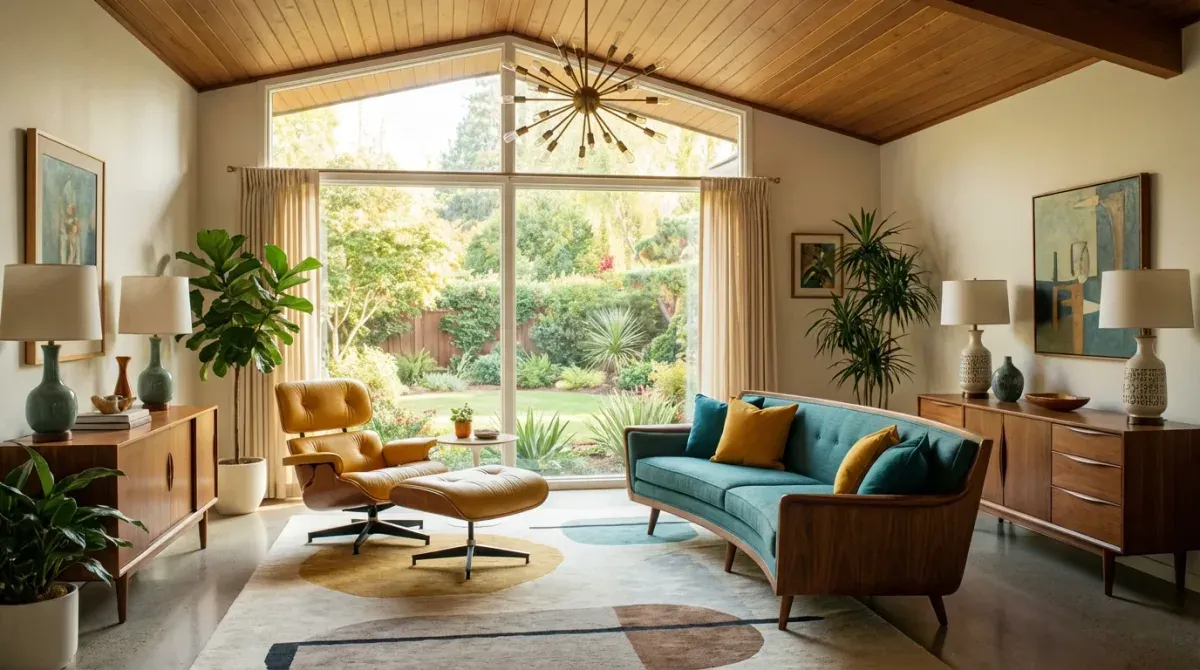
The MCM living room is oriented toward conversation and the integration of indoor and outdoor spaces:
- Modular sofa in warm neutral upholstery — teak or walnut frame legs visible
- Eames-style lounge chair or Tulip chair as the signature accent seat
- Walnut credenza along one wall — both storage and display surface
- Sputnik chandelier or arc floor lamp as statement lighting
- Large abstract rug in geometric pattern with mustard or teal accent
- Gallery of graphic/abstract artwork — original prints or quality reproductions
Large picture windows, where present, should be maximally exposed — MCM design specifically integrates the garden as an extension of the interior.
Bedroom
MCM bedrooms are clean, ordered, and quietly sophisticated:
- Low-profile platform bed with walnut or teak frame
- Matching bedside tables in walnut — simple, tapered-leg forms
- Teak or walnut dresser with simple bar pulls in brass or chrome
- Arc floor lamp positioned over a reading chair in the corner
- Single bold accent color in bedding — mustard, teal, or terracotta
Dining Room
The MCM dining room is where sculptural furniture makes the strongest impact:
- Oval or round Tulip-style table in white laminate or walnut veneer with pedestal base
- Wishbone chairs or Eames shell chairs — functional, stackable, visually light
- Sputnik or Nelson pendant centered over the table
- Walnut sideboard with sliding panel doors for serving and display
Home Office
MCM home office design is the most naturally productive environment:
- Walnut or teak desk with tapered legs and integrated storage
- Eames management or executive chair or equivalent form
- Built-in walnut shelving — modular units from floor to ceiling
- Task lighting in period-appropriate arc or gooseneck form
- Abstract prints that motivate without distracting
How to Visualize MCM in Your Home
The best way to understand how MCM will work in your specific space is to see it rendered in your actual room. Different wall colors, floor materials, and room proportions respond differently to MCM's warm palette and horizontal furniture profiles.
AI tools like RoomLift let you upload a photo of any room and generate a photorealistic MCM redesign in under 60 seconds. Test walnut vs teak tones against your existing walls, see whether your room suits the warmer American MCM aesthetic or the lighter Danish modern interpretation, and compare accent color options before making any purchases.
Visualize mid century modern in your room — 5 free renders →
Sources & References
- American Society of Interior Designers (2024). Interior Design Outlook and State of the Industry. ASID Research.
- Houzz (2024). Houzz Home Study: Emerging Design Trends. Houzz Research.
Ready to transform your listings?
Stage your first room in 20 seconds. No design skills needed.